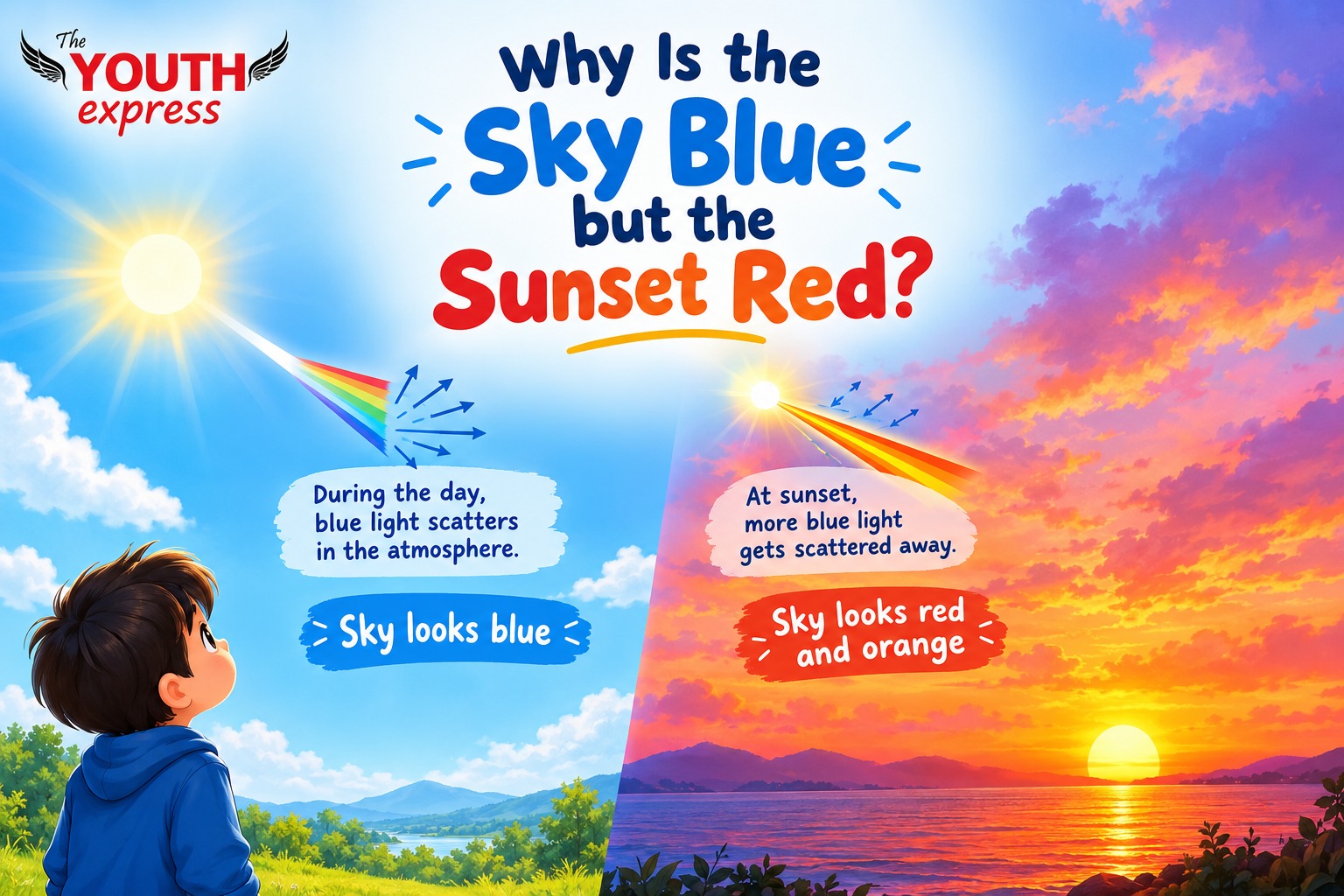
Have you ever looked at the sky on a bright sunny day and wondered, why is the sky blue? Then, as evening arrives, you may notice something completely different. The blue sky slowly changes into shades of yellow, orange, pink, and red.
It may seem like the sky is changing its colour, but there is an amazing scientific reason behind this beautiful phenomenon. The answer lies in sunlight, Earth's atmosphere, and the way light travels.
For children, the sky is like a giant science experiment happening above their heads every day. Just like asking why the sky changes colour can lead to an interesting discovery, being curious about everyday things can help children learn more about the world. You can also read [Why Do We Get Curious? The Science of Curiosity] to discover why asking questions is such an important part of learning.
What Colour Is Sunlight?
We often think of sunlight as simply white or yellow. However, sunlight is actually made up of many different colours.
These colours include red, orange, yellow, green, blue, indigo, and violet. You can see them clearly when sunlight passes through raindrops and creates a rainbow.
Each colour of light has a different wavelength. Red light has a longer wavelength, while blue and violet light have shorter wavelengths.
When sunlight travels from the Sun towards Earth, it eventually enters our atmosphere—the layer of gases surrounding our planet. This is where the interesting part begins.
How Does Sunlight Make the Sky Blue?
Earth's atmosphere contains tiny molecules of gases, mainly nitrogen and oxygen. When sunlight passes through these molecules, the light gets scattered in different directions.
This process is known as Rayleigh scattering.
Blue and violet light have shorter wavelengths, so they are scattered much more strongly than colours with longer wavelengths, such as red and orange.
The scattered blue light spreads throughout the atmosphere. Since we can see this scattered light from different directions, the sky appears blue during the daytime.
But if violet light is scattered even more strongly than blue light, why don't we see a violet sky?
One reason is that our eyes are more sensitive to blue light than violet. Some violet light is also absorbed in the upper atmosphere. Because of this, our eyes perceive the daytime sky mainly as blue.
Why Isn't the Sky Blue at Night?
At night, the Sun is below the horizon, so sunlight is no longer directly reaching the atmosphere above us.
Without sunlight entering the atmosphere, there is very little scattered sunlight reaching our eyes. That's why the blue colour disappears and the sky looks dark.
Instead, we can see objects such as the Moon, stars, and planets.
This is one reason why looking at the night sky can be so fascinating. There is an enormous universe beyond our atmosphere, filled with objects that scientists continue to study and explore.
Why Does the Sunset Look Red?
Now comes the most beautiful part—the sunset.
During the middle of the day, the Sun is relatively high in the sky. Sunlight travels through a shorter distance of atmosphere before reaching our eyes.
But during sunrise and sunset, the Sun is close to the horizon. Its light has to travel through a much longer path across Earth's atmosphere.
As sunlight travels this longer distance, much of the blue and violet light gets scattered away in different directions.
The colours with longer wavelengths, particularly red, orange, and yellow, are more likely to continue travelling through the atmosphere and reach our eyes.
This is why the setting Sun and the surrounding sky can appear orange or red.
Why Are Some Sunsets More Colourful Than Others?
Have you ever noticed that one sunset looks simple and golden while another fills the entire sky with shades of red, pink, orange, and purple?
This happens because the appearance of a sunset depends on conditions in the atmosphere.
Tiny particles such as dust, smoke, pollution, water droplets, and aerosols can affect how sunlight is scattered.
Clouds can also make sunsets look more dramatic. They can reflect and scatter sunlight, creating beautiful combinations of colours across the sky.
The exact colours we see depend on several factors, including clouds, humidity, atmospheric particles, air quality, and the position of the Sun.
That's why no two sunsets have to look exactly the same.
Why Can the Sky Look Pink or Purple?
A sunset doesn't always appear simply red or orange. Sometimes you may see pink, purple, golden, or even several colours at once.
Different wavelengths of sunlight are scattered in different ways as the light travels through the atmosphere. Clouds can also reflect the remaining sunlight and add to the colourful display.
This creates the beautiful combinations we sometimes see just before the Sun disappears below the horizon.
In a way, nature creates a new painting in the sky every evening.
Is Sunrise Caused by the Same Science?
Yes!
The same basic science explains the colours we see during sunrise.
When the Sun is just appearing above the horizon, its light has to travel through a longer path in the atmosphere before reaching our eyes.
More of the shorter-wavelength blue light is scattered away, allowing more of the red, orange, and yellow light to reach us.
That's why early mornings can also have beautiful red, orange, pink, and golden skies.
A Simple Way to Remember It
You can remember the whole process with two simple steps.
During the Day
Sunlight enters the atmosphere → blue light scatters in many directions → the sky appears blue.
During Sunset
Sunlight travels through more atmosphere → more blue light is scattered away → red and orange light reaches our eyes.
So, the same sunlight can create different colours depending on how far it travels through Earth's atmosphere.
What Does This Teach Us About Science?
The blue sky and colourful sunset show us that science isn't limited to a classroom or textbook.
Simple questions such as “Why is the sky blue?” can lead us to learn about light, wavelengths, gases, Earth's atmosphere, and even astronomy.
This is also why encouraging children to observe the world around them is so valuable. A curious child may look at an ordinary sunset and discover an entire world of science behind it.
For more interesting science, history, current events, stories, and educational content created especially for young readers, explore [Youth Express].
Did You Know?
The colours we see in the sky can also help scientists study Earth's atmosphere.
Scientists observe how light interacts with gases and tiny particles to understand different atmospheric conditions. The science of light scattering is also important in fields such as atmospheric science and astronomy.
Even something as ordinary as a blue sky can therefore tell us something about the world around us.
Final Thoughts
The next time you look at a bright blue sky or watch a beautiful red sunset, remember that you are witnessing science in action.
The sky isn't actually painted blue during the day or red in the evening. These colours appear because sunlight interacts with gases and tiny particles in Earth's atmosphere.
During the day, blue light is scattered throughout the atmosphere, making the sky appear blue. During sunrise and sunset, sunlight travels through a much longer path, scattering more of the blue light and allowing more red, orange, and yellow light to reach our eyes.
So, the next time you see a colourful sunset, don't just admire its beauty—think about the amazing science behind it!
Nature gives us a spectacular science lesson every single day, right above our heads. And sometimes, all it takes to discover that lesson is one simple question: “Why?”