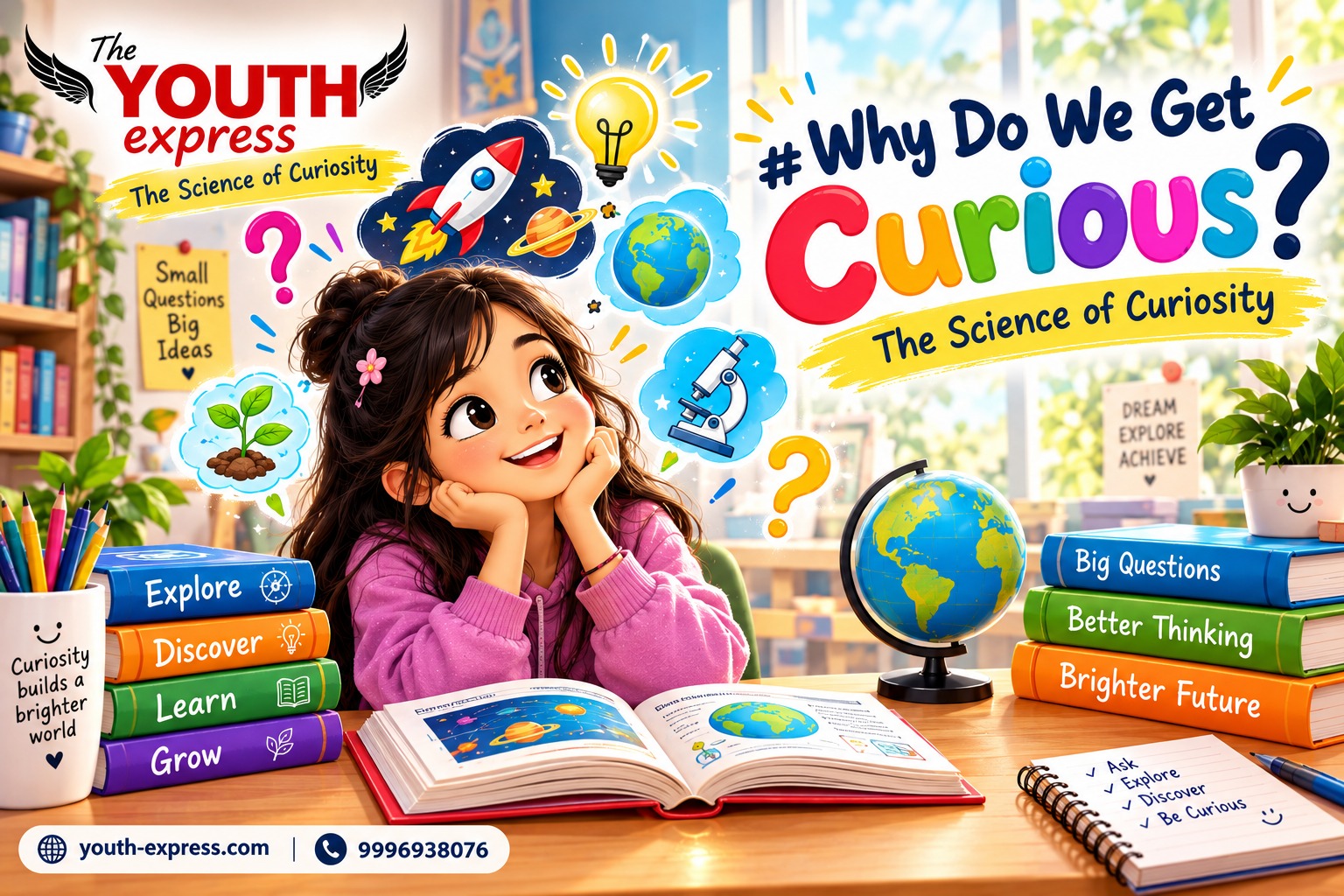
Children are naturally curious. They notice small things, wonder how the world works, and constantly look for answers. This natural desire to understand something new is called curiosity.
But why do we become curious in the first place? What happens inside our brain when we want to know something? And why does curiosity play such an important role in learning?
Curiosity is not simply about asking questions. It is one of the ways our brain encourages us to explore, discover, and understand the world around us.
What Is Curiosity?
Curiosity is the desire to learn, explore, or discover something that we do not fully understand.
When children come across something unfamiliar, their minds naturally want to make sense of it. This can encourage them to observe more carefully, ask questions, search for information, and try things for themselves.
For example, a child may see a plant growing from a tiny seed and become interested in understanding how it happens. Finding the answer can lead to learning about sunlight, water, soil, roots, and photosynthesis.
One small moment of curiosity can therefore turn into a much bigger learning experience.
Why Curiosity Drives Invention
Curiosity has inspired many great discoveries and inventions throughout history. It encourages people to ask “why” and “how,” explore new ideas, and experiment without always having a specific problem to solve. From Alexander Graham Bell's experiments with sound to Isaac Newton's questions about gravity and motion, curiosity has helped shape our understanding of the world. In many cases, a simple question can become the starting point for a discovery that changes how we live.
What Happens in the Brain When We Are Curious?
Our brain likes to make sense of information. When we know something, we usually feel that we understand it. But when we discover that there is something we do not know, our brain becomes interested in finding the missing information.
This is sometimes described as a curiosity gap.
Imagine that a child knows that the Moon changes its appearance during the month but does not know why. That gap between what the child knows and what they want to understand can create curiosity.
The child may then look for an explanation, read about the Moon, watch an educational video, or ask a teacher or parent.
The search for an answer is itself a learning process.
Curiosity Makes Learning More Meaningful
Children often remember information better when they genuinely want to know it.
There is a big difference between learning something because you have to remember it and learning something because you are interested in discovering the answer.
Curiosity gives children a reason to explore a subject. It can make a science experiment more exciting, a history story more interesting, and a new word worth remembering.
This is one reason reading can be such a powerful learning habit for children. A children's newspaper can introduce young readers to new topics, events, discoveries, people, and places that naturally encourage them to learn more.
You can also explore How Reading Newspapers Builds Critical Thinking in Children to understand how regular reading can support children's thinking and learning.
Curiosity Helps Build Critical Thinking
Curious children do not always stop after finding the first answer. They may ask another question.
They may wonder:
How do we know this is true?
Why did this happen?
Could there be another explanation?
What would happen if we changed something?
Where did this information come from?
These kinds of questions encourage children to think carefully instead of simply accepting information.
Over time, curiosity can help children develop skills such as observation, reasoning, problem-solving, and critical thinking.
Curiosity and Creativity Go Together
Curiosity can also encourage creativity.
When children wonder how something works, they may try to build their own version. When they become interested in art, they may experiment with colours and shapes. When they become fascinated by nature, they may start drawing, writing, photographing, or collecting observations.
Curiosity gives children the motivation to explore possibilities.
Not every experiment will work, and not every idea will be correct. But making mistakes and trying again can teach children how to approach problems in new ways.
Why Reading Can Increase Curiosity
Reading exposes children to ideas they may not encounter in their everyday surroundings.
A child can travel through history, explore outer space, discover unusual animals, learn about different cultures, or follow the story of an important invention—all through reading.
Each new topic can create another question.
A regular reading habit can therefore become a cycle:
Read → Discover → Ask → Explore → Learn → Ask Again
This is one of the reasons How Kids' Newspapers Improve Language and Thinking can be a useful related topic for parents interested in developing their child's reading habit.
A children's newspaper can be particularly useful because it connects reading with the real world and gives children new subjects to explore.
How Parents Can Encourage Curiosity
Parents do not need to know the answer to every question. Sometimes, discovering the answer together can be even more valuable.
Here are some simple ways parents can encourage curiosity:
1. Welcome Questions
Allow children to ask questions without making them feel that they are asking “too much.” Questions are often the starting point of learning.
2. Ask What They Think
Before explaining something, ask your child what they think the answer might be. This encourages them to reason and form their own ideas.
3. Explore Together
Use books, newspapers, experiments, museums, nature walks, and reliable educational resources to explore interesting questions.
4. Let Children Experiment
Simple activities can turn curiosity into hands-on learning. Growing a plant, observing the Moon, making a paper model, or testing how different objects behave in water can all become learning opportunities.
5. Create Time for Offline Discovery
Children need time to read, play, observe, imagine, and explore without constantly being entertained by a screen. For practical ideas, see 5 Effective Ways to Reduce Screen Time in Kids.
Curiosity Can Begin Anywhere
Curiosity does not require a classroom or complicated equipment.
It can begin while walking through a park, reading a newspaper, looking at the night sky, watching an insect, cooking with a parent, or simply noticing something unusual.
The important thing is to encourage children to pause and wonder.
A simple question can lead to research. Research can lead to discovery. Discovery can lead to another question.
That is how curiosity keeps learning moving forward.
Conclusion
Curiosity is a natural part of being human, but childhood is a particularly important time to encourage it. When children are curious, they are more willing to explore, ask questions, experiment, and search for explanations.
Curiosity can support learning, creativity, problem-solving, and critical thinking. More importantly, it can help children develop a lifelong desire to understand the world around them.
At The Youth Express, we believe reading should do more than provide information. It should encourage young minds to discover something new and ask what comes next.
Because learning does not always begin with an answer.