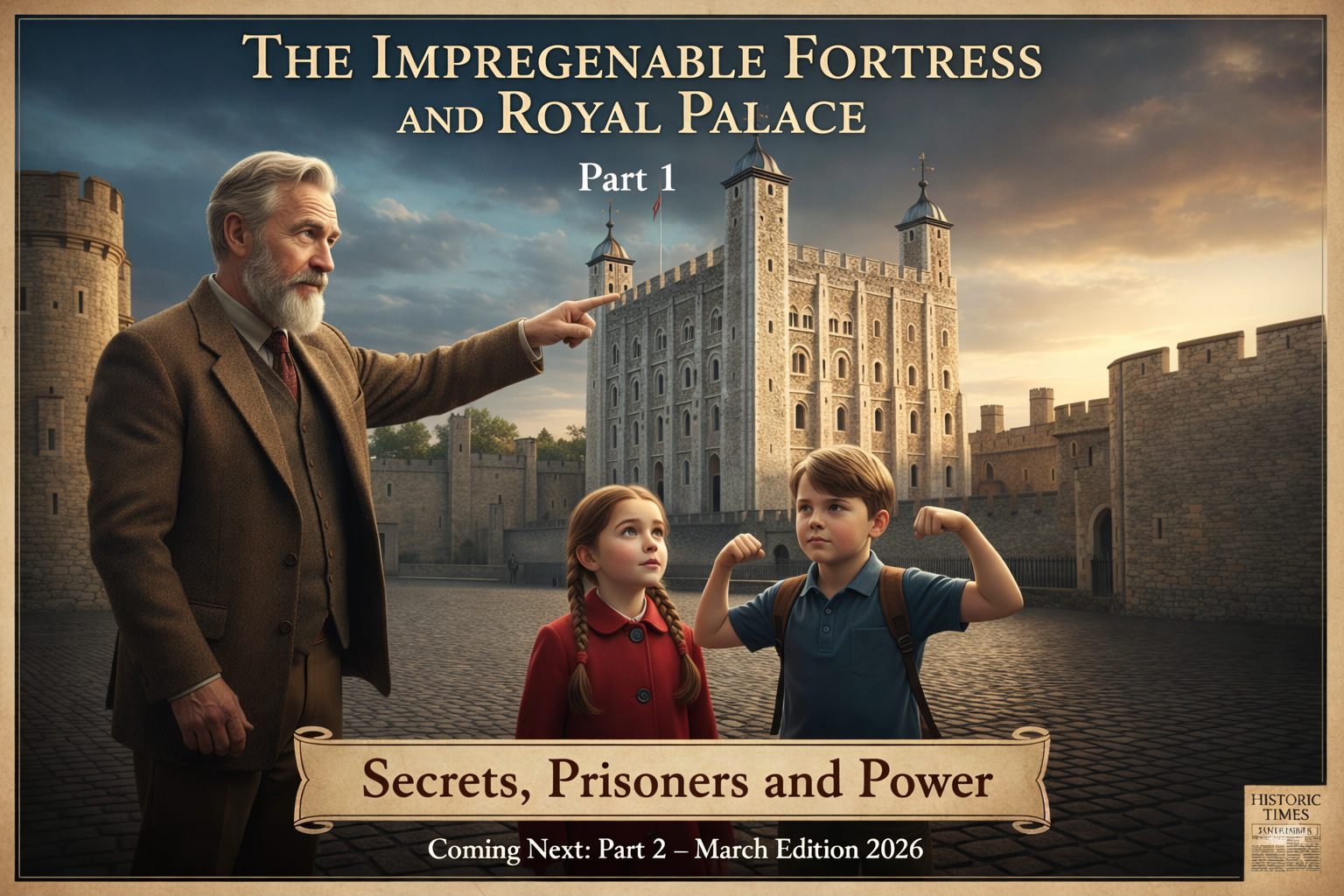
The Impregnable Fortress and Royal Palace – (Part 1)
The story of the White Tower, the central keep of the Tower of London, is the story of nearly a millennium of
English history. Its construction was a political statement, asserting total Norman dominance.
Grandfather and two grandchildren (Lily and Tom) are at the Tower of London. Grandfather points to the
White Tower.
Grandfather: “Welcome, my little adventurers, to the Tower of London! And right there, that big white
building, is the oldest part of all: the White Tower!”
Lily: “Wow! It looks like a giant castle!”
Tom: He looks super strong!
1078
Grandfather: “That’s right, Lily! A very long time ago, in 1078, a powerful king named William the
Conqueror built it to show everyone who was boss!”
Grandfather: “It wasn’t just a fortress! Kings and queens lived here too, with grand halls and even a
beautiful church inside, like this one!”
Lily: “It’s so peaceful in here!”
WHITE!
Tom: He liked bright colors!
Grandfather: “Later, a king named Henry III decided it looked a bit dull. So he ordered it to be painted
white! And that’s how it got its name!”
Foundation and Purpose (1078 – c.1100)
William the Conqueror commissioned the Tower shortly after 1066. Work on the great stone keep, designed
to assert Norman authority over the conquered English, began around 1078. The architect was traditionally
Gundulf, Bishop of Rochester.
Norman Design
The Tower was revolutionary for its time, built using local stone and imported Caen stone from Normandy.
It represents a prime example of Norman military architecture.
The Royal Core
The keep housed the essential functions of a royal castle: military defense, royal accommodation (including
a Great Hall), and the stunning Chapel of St. John the Evangelist, one of the finest Romanesque chapels in
Europe. As early as 1101, it also served as a state prison.
Whitewashing and Naming
In 1240, Henry III ordered the structure to be whitewashed inside and out. This act, done to protect the
stone and give it a dazzling appearance, permanently gave the building its famous name: the White Tower.
The Twist…
But the White Tower’s story does not end with its walls being painted white.
Behind these strong stones lie secret stories of prisoners, powerful rulers, and dramatic events that shaped
England forever.
👉To read the next exciting part of this story, subscribe to our newspaper and continue the
adventure with us.
Coming Next:Part 2 – Secrets, Prisoners and Power (March Edition 2026)