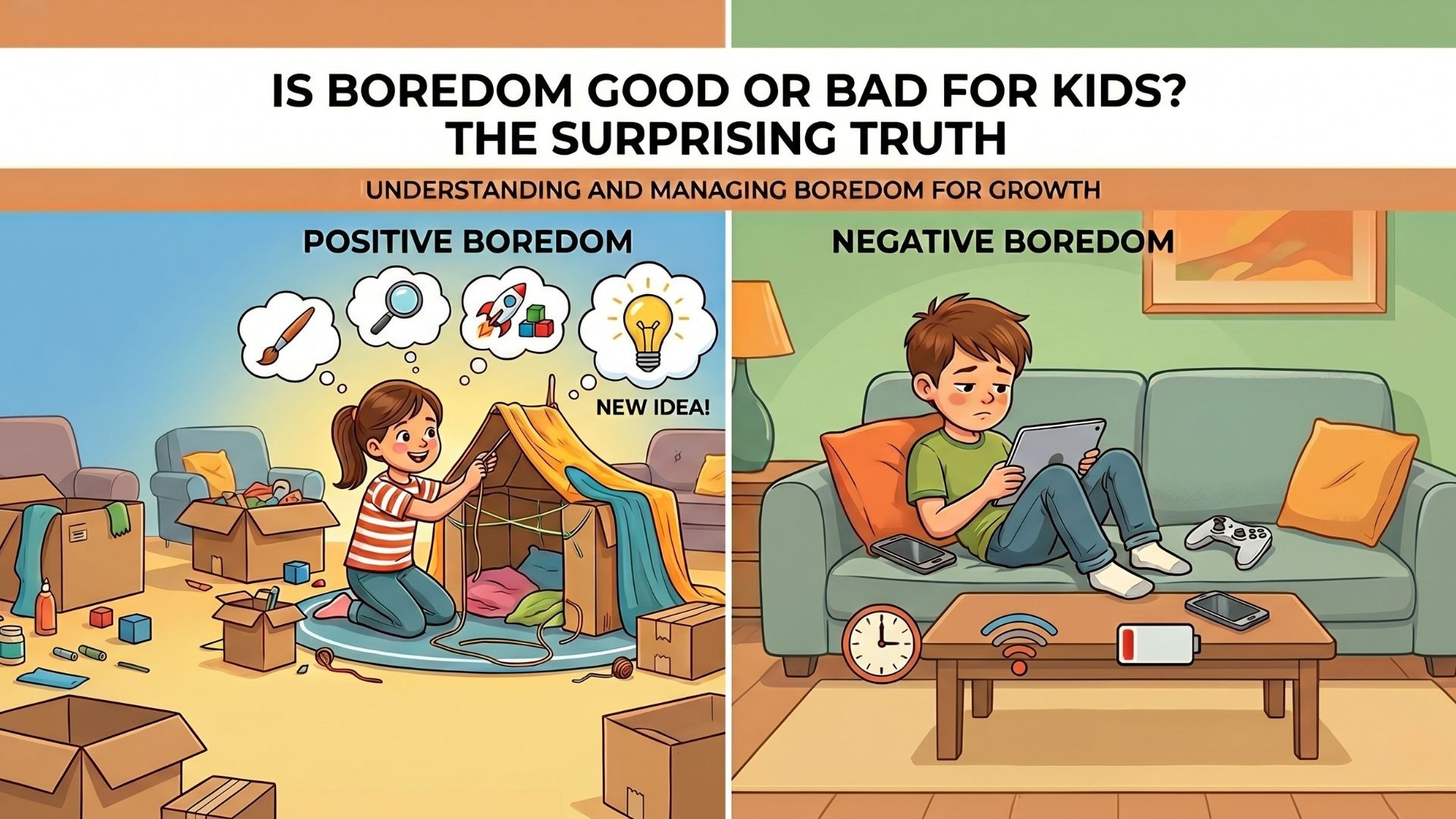
Is Boredom Good or Bad for Kids? The Surprising Truth
Boredom in kids is a common situation where children feel uninterested or have nothing
engaging to do. It happens in daily life at home, school, or during free time.
Many people believe boredom in kids is harmful. But the reality is different. In some cases, it
helps children think better and become more creative.
So, boredom in kids should not always be avoided. It should be understood and managed
correctly.
Section 1: Understanding Boredom in Kids
Boredom is a mental state. It appears when:
● Activities feel repetitive
● There is no challenge
● Interest level is low
Boredom in kids is a signal that the brain is not fully engaged.
Section 2: Positive vs Negative Boredom
There are two types of boredom in kids:
Positive Boredom:
● Encourages imagination
● Leads to new ideas
● Promotes independent thinking
Negative Boredom:
● Causes distraction
● Leads to overuse of mobile devices
● Creates lack of focus
The effect depends on how children respond to boredom.
Section 3: Brain Logic Behind Boredom
The brain always looks for stimulation.
When there is:
● No new activity
● No challenge
● No excitement
Then boredom in kids begins.
This pushes the brain to search for something interesting, which can improve thinking ability.
Section 4: Environmental Impact
Environment plays a big role in boredom in kids:
● Too much indoor time
● Limited activities
● No social interaction
● Fixed daily routine
A balanced environment helps reduce harmful boredom.
Section 5: Mental Engagement Factors
Children feel bored when:
● Tasks are too easy
● Tasks are too difficult
● There is no personal interest
Boredom in kids increases when learning is not interactive.
Better engagement methods:
● Activity-based learning
● Real-life examples
● Group participation
Section 6: Emotional Impact
Emotions affect boredom in kids:
● Low confidence → Avoid tasks
● Fear of mistakes → No effort
● Lack of appreciation → No interest
Support and encouragement reduce boredom.
Section 7: Role in Skill Development
Boredom in kids can help in skill growth:
● Encourages trying new things
● Develops problem-solving
● Builds patience
● Improves focus
Children often discover new hobbies when they feel bored.
Section 8: What Research Shows
Studies suggest:
● Boredom supports creativity
● It improves independent thinking
● It helps in decision-making
● It increases curiosity
● It builds mental strength
Controlling boredom in kids is beneficial.
Key Takeaway
● Boredom in kids is natural
● It can be useful if managed well
● It supports creativity and thinking
● Environment affects boredom levels
● Proper guidance is important
Frequently Asked Questions (FAQ)
Q1. Should kids always stay busy?
No. Some free time is important for growth.
Q2. Is boredom necessary for creativity?
Yes. It encourages children to think and create.
Q3. What causes boredom in kids?
Lack of interest, no challenge, and repetitive tasks.
Q4. How to handle boredom in kids?
Provide balanced activities and encourage creativity.