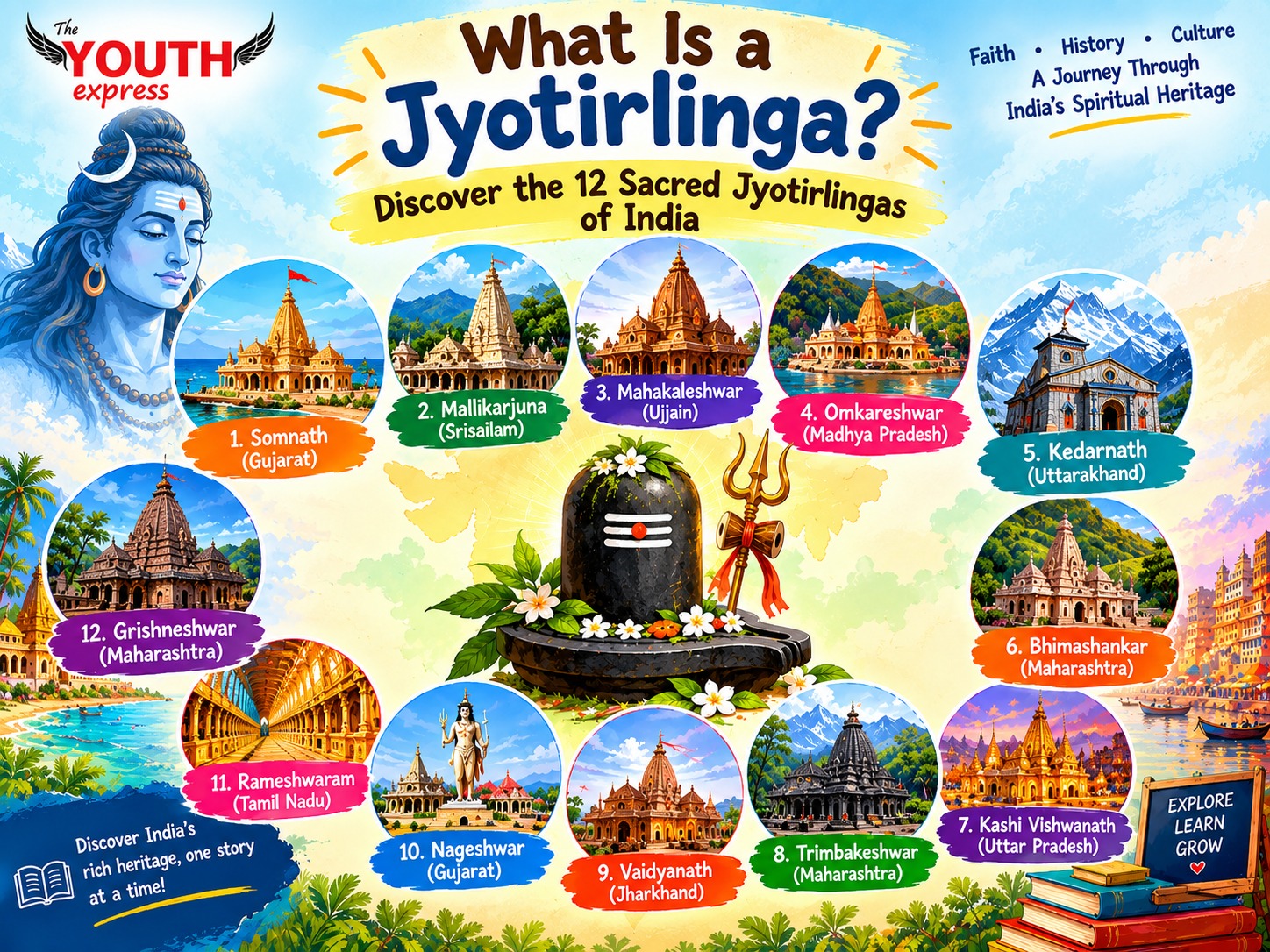
India is known for its ancient temples, fascinating mythology, and rich spiritual traditions. Among the many sacred places dedicated to Lord Shiva, the Jyotirlingas hold a very special place.
But what exactly is a Jyotirlinga? Why are there 12 Jyotirlingas? And where can they be found?
Let us explore the fascinating world of the 12 Jyotirlingas of Lord Shiva.
What Is a Jyotirlinga?
The word Jyotirlinga comes from two Sanskrit words: “Jyoti,” meaning light or radiance, and “Linga,” representing Lord Shiva.
According to Hindu tradition, a Jyotirlinga represents the divine and infinite form of Lord Shiva. It is believed that Lord Shiva appeared as a boundless pillar of light, showing that his divine nature has no beginning or end.
The Jyotirlingas are therefore considered highly sacred places where devotees worship Lord Shiva.
There are 12 Jyotirlingas traditionally recognised across India. Each one is associated with a particular place and has its own legends, traditions, and cultural importance.
The Story Behind the Jyotirlinga
One famous story explains the origin of the Jyotirlinga.
According to Hindu mythology, Lord Brahma and Lord Vishnu once had a disagreement about who was more powerful. At that moment, Lord Shiva appeared before them as a gigantic pillar of light.
The pillar seemed to have no beginning and no end.
Lord Vishnu travelled downward to find its lower end, while Lord Brahma travelled upward to find its top. However, neither could discover the limits of the mysterious pillar.
The story symbolises that the divine nature of Lord Shiva is infinite and beyond human understanding.
This pillar of light is known as the Jyotirlinga.
The 12 Jyotirlingas of India
The twelve Jyotirlingas are spread across different parts of India. Each temple has a unique location and cultural history.
1. Somnath – Gujarat
The Somnath Jyotirlinga is located at Prabhas Patan in Gujarat, near the Arabian Sea. It is traditionally considered the first of the twelve Jyotirlingas.
The temple has a long history and has been rebuilt several times over the centuries.
2. Mallikarjuna – Srisailam
The Mallikarjuna Jyotirlinga is located at Srisailam in the Nallamala Hills.
The temple is associated with Lord Shiva and Goddess Parvati and is an important pilgrimage destination.
3. Mahakaleshwar – Ujjain
The Mahakaleshwar Jyotirlinga is located in Ujjain, Madhya Pradesh.
Lord Shiva is worshipped here as Mahakaleshwar, meaning the Lord of Time. The temple is also famous for its traditional Bhasma Aarti.
4. Omkareshwar – Madhya Pradesh
The Omkareshwar Jyotirlinga is located on an island in the Narmada River.
The island is traditionally associated with the sacred symbol Om (ॐ), giving the temple its distinctive identity.
5. Kedarnath – Uttarakhand
The Kedarnath Jyotirlinga is located high in the Himalayan region of Uttarakhand.
Surrounded by magnificent mountains, Kedarnath is one of India's most famous pilgrimage destinations.
6. Bhimashankar – Maharashtra
The Bhimashankar Jyotirlinga is located in Maharashtra's Sahyadri region.
The temple is surrounded by forests and hills, making it a fascinating combination of spirituality and natural beauty.
7. Kashi Vishwanath – Uttar Pradesh
The Kashi Vishwanath Jyotirlinga is located in Varanasi, Uttar Pradesh.
The name Vishwanath means “Lord of the Universe.” The temple is one of the most famous Shiva temples in India.
8. Trimbakeshwar – Maharashtra
The Trimbakeshwar Jyotirlinga is located near Nashik in Maharashtra.
The temple is closely connected with the origin of the Godavari River and is known for its traditional architecture.
9. Vaidyanath – Jharkhand
The Vaidyanath Jyotirlinga, also known as Baidyanath, is traditionally associated with Deoghar in Jharkhand.
The name Vaidyanath is connected with Lord Shiva as a divine healer.
10. Nageshwar – Gujarat
The Nageshwar Jyotirlinga is traditionally associated with the Dwarka region of Gujarat.
The temple is dedicated to Lord Shiva and is known for its peaceful surroundings and large statue of Lord Shiva.
11. Rameshwaram – Tamil Nadu
The Rameshwaram Jyotirlinga is located in the famous Ramanathaswamy Temple in Tamil Nadu.
The temple is particularly famous for its long corridors, beautifully carved pillars, and magnificent architecture.
12. Grishneshwar – Maharashtra
The Grishneshwar Jyotirlinga is located near Ellora in Maharashtra.
The temple is an important Shiva pilgrimage site and is known for its traditional architecture and historical surroundings.
Why Are Jyotirlingas Important?
The Jyotirlingas connect faith, mythology, history, architecture, and Indian culture.
Each Jyotirlinga has its own story and traditions. Together, the twelve temples are spread across different regions of India, taking visitors through mountains, rivers, ancient cities, and coastal landscapes.
For children, learning about Jyotirlingas can be a wonderful way to discover India's history, geography, mythology, and cultural heritage.
Learn About India's Heritage with The Youth Express
Children learn best when information is presented through interesting stories and easy-to-understand content. The Youth Express brings young readers engaging educational content that helps them explore India's history, culture, traditions, science, and the world around them.
A news magazine for kids can be a great screen-free way for children to develop a regular reading habit while discovering new ideas and fascinating facts.
Explore more interesting and educational stories with The Youth Express and make learning a fun part of your child's everyday reading.
Interesting Facts About Jyotirlingas
There are traditionally 12 major Jyotirlingas.
Jyoti means light or radiance.
Jyotirlingas are sacred places associated with Lord Shiva.
The 12 Jyotirlingas are located across different parts of India.
Each Jyotirlinga has its own legends, traditions, and cultural significance.
Many Jyotirlinga temples are also known for their remarkable architecture and historical importance.
Conclusion
A Jyotirlinga represents the sacred and infinite form of Lord Shiva and holds an important place in Indian spiritual traditions.
The 12 Jyotirlingas take us on a fascinating journey across India—from the mountains of Kedarnath to the shores of Somnath and the ancient city of Varanasi.
Learning about these sacred temples is not only a way to understand mythology but also an opportunity to explore India's history, geography, architecture, and cultural heritage.
For young readers, stories like these can make learning about India's rich heritage exciting, meaningful, and memorable.