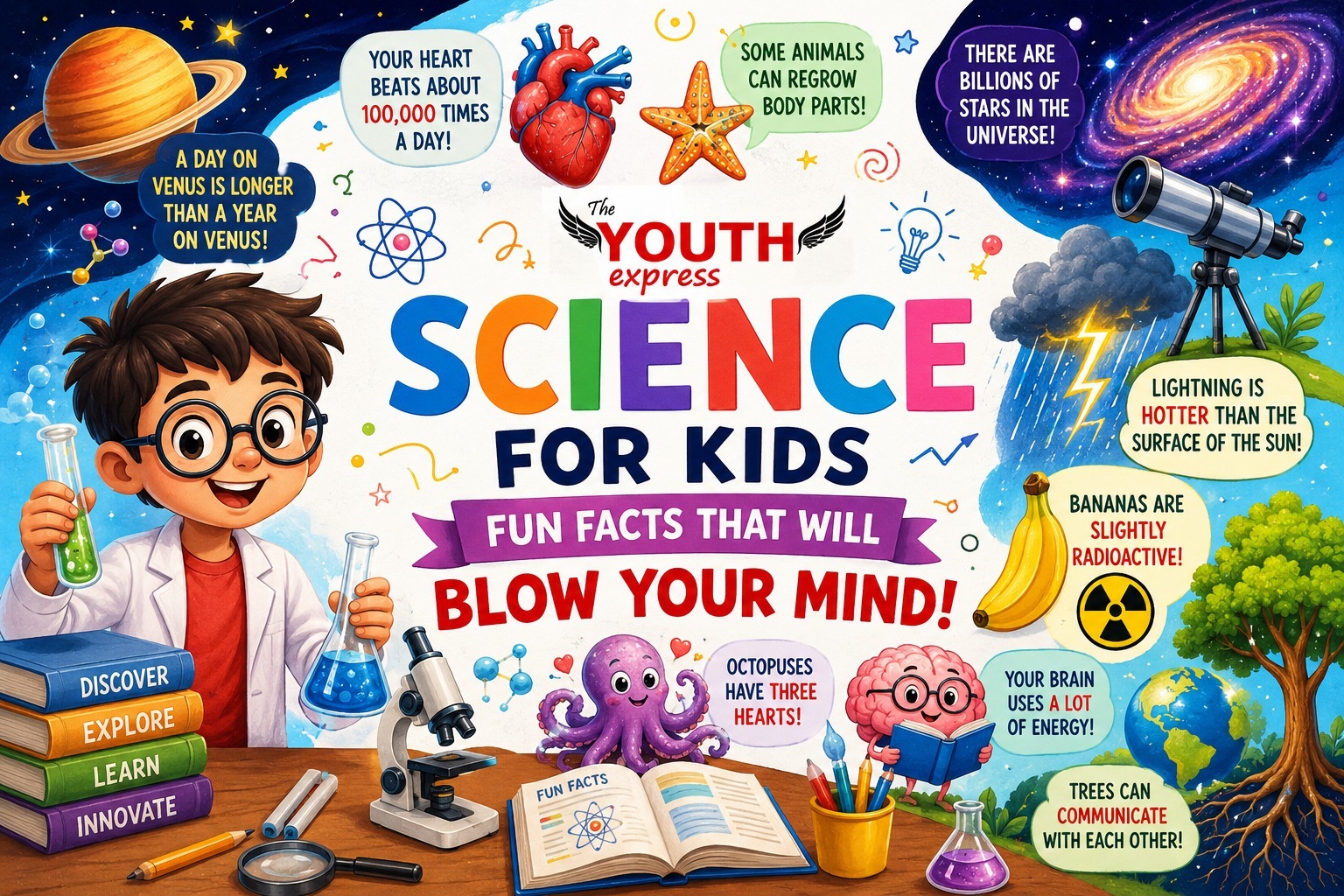
Science is everywhere. It is in the food we eat, the air we breathe, the stars we see, and even inside our own bodies. For children, science is not just a school subject. It is a wonderful way to understand how the world works.
The best part? Science can be full of surprises!
From animals that can survive extreme conditions to planets with incredible weather, the world is packed with amazing discoveries. Here are some fun science facts for kids that will make learning science more exciting.
1. A Day on Venus Is Longer Than a Year on Venus
Venus is one of the closest planets to Earth, but it has a very unusual schedule.
It takes Venus about 243 Earth days to rotate once on its axis. However, it takes only about 225 Earth days to travel around the Sun.
That means a day on Venus is actually longer than its year!
Imagine having a birthday before your day was even over!
2. Your Heart Beats Thousands of Times Every Day
Your heart is like a tiny pump that works all day and night without taking a break.
An average human heart beats around 100,000 times in a day. It pumps blood throughout your body, delivering oxygen and nutrients to different organs.
Even while you are sleeping, your heart keeps working.
Isn't the human body amazing?
3. Some Animals Can Regrow Body Parts
Nature has some incredible tricks.
For example, starfish can regrow lost arms, while some types of salamanders can regenerate limbs and other body parts.
Scientists study these animals to understand how regeneration works. Their discoveries may even help researchers learn more about repairing damaged human tissues in the future.
4. There Are More Stars Than You Can Count
Look up at the night sky and you may see thousands of stars. But what you see is only a tiny part of the universe.
Our galaxy, the Milky Way, contains billions of stars. And scientists believe there are billions of galaxies in the observable universe.
The universe is so enormous that even the biggest numbers can feel surprisingly small!
5. Water Can Exist in Three Forms
You probably already know that water can be liquid. But did you know water can naturally exist in three different forms?
Solid: Ice
Liquid: Water
Gas: Water vapour
When ice melts, it becomes liquid water. When water gets heated enough, it turns into water vapour.
This simple process is an important part of Earth's water cycle.
6. Bananas Are Slightly Radioactive
Don't worry—you don't need to stop eating bananas!
Bananas contain a small amount of potassium, including a naturally occurring radioactive isotope called potassium-40.
The amount is extremely tiny and harmless. In fact, many foods contain naturally occurring radioactive elements.
So yes, your banana is technically a little radioactive!
7. Octopuses Have Three Hearts
Octopuses are already fascinating animals, but their bodies have an especially unusual feature.
An octopus has three hearts. Two pump blood toward the gills, while the third pumps blood to the rest of the body.
Even more interestingly, the main heart stops beating while the octopus swims!
The ocean is truly full of strange and wonderful creatures.
8. Lightning Is Extremely Hot
Lightning may look beautiful from far away, but it is incredibly powerful.
The air around a lightning bolt can become hotter than the surface of the Sun for a very short moment.
The sudden heating causes the air to expand rapidly, producing the loud sound we know as thunder.
So the next time you hear thunder, remember that you are hearing the result of an incredible natural event.
9. Your Brain Uses a Lot of Energy
The human brain may not be very large compared with the rest of your body, but it is a very busy organ.
Your brain uses a significant amount of your body's energy. It helps you think, remember, learn, move, solve problems, and control many functions automatically.
Every time a child reads a story, solves a puzzle, or learns something new, their brain is working hard.
That is one reason learning activities for kids are so valuable.
10. Sound Cannot Travel Through Space
Movies sometimes show explosions making loud sounds in space. In real life, things are different.
Sound needs a medium, such as air, water, or another material, to travel through. Since outer space is mostly a vacuum, there is no air for sound waves to move through.
That means space is much quieter than it looks in movies!
11. Some Trees Communicate With Each Other
Trees may not talk like humans, but forests can have surprisingly complex underground connections.
Fungi living around tree roots can form networks that help move nutrients and chemical signals through the soil.
Scientists are still studying these relationships and discovering more about how plants interact with their environment.
12. A Cloud Can Weigh Hundreds of Tonnes
Clouds look light and fluffy, but they can contain a huge amount of water.
A typical cloud can contain hundreds of tonnes of water, spread across millions of tiny droplets or ice crystals.
So why doesn't a cloud simply fall from the sky? The water droplets are extremely small and are supported by moving air. When they combine and become heavy enough, they can fall as rain.
Why Should Kids Learn Science?
Science encourages children to ask questions, observe carefully, experiment, and think critically. It helps them understand everyday things, from why plants need sunlight to how magnets work.
Fun science facts can also make children curious about subjects they may initially find difficult. A surprising fact can lead to a question, and that question can lead to further learning.
Parents can encourage this curiosity by discussing interesting facts at home, visiting science museums, trying simple experiments, reading educational books, or exploring children's newspapers that introduce young readers to science and the world around them.
Final Thoughts
Science is not only about formulas, laboratories, and textbooks. It is about discovering the incredible things happening around us every day.
From three-hearted octopuses to enormous clouds and mysterious planets, there is always something new to discover.
So keep asking questions, keep exploring, and never stop being curious. The more you learn about science, the more amazing our world becomes!
Frequently Asked Questions
1. Why is science important for kids?
Science helps kids understand how the world around them works. It encourages curiosity, observation, problem-solving, and critical thinking. Learning science through fun facts and simple activities can make education more interesting and enjoyable.
2. What are some fun ways to teach science to children?
Parents can teach science through simple experiments, interesting science facts, nature walks, educational videos, books, puzzles, and children’s newspapers. Connecting science with everyday life helps children understand concepts more easily.