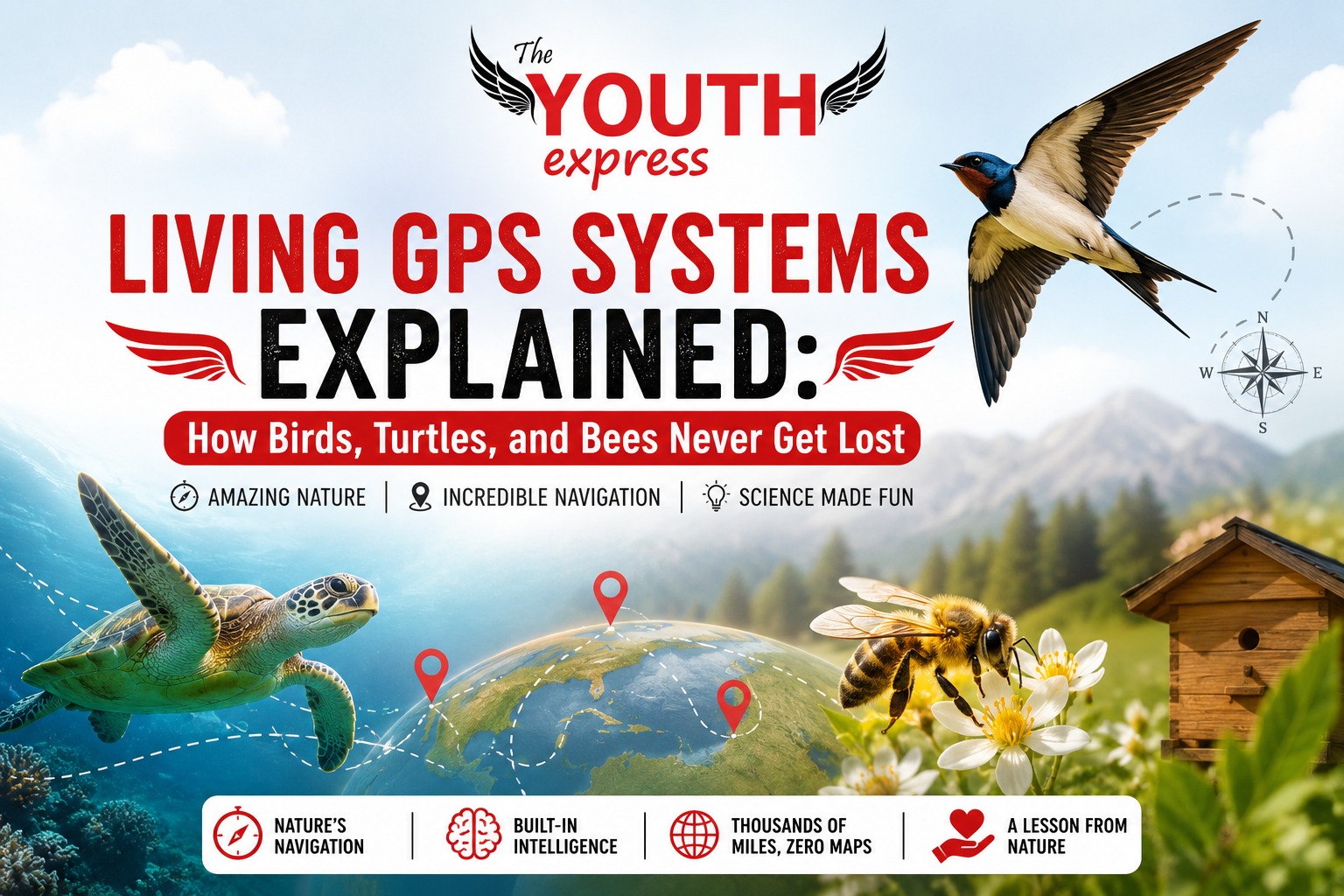
Have you ever wondered how birds fly thousands of kilometers every year without using Google Maps? Or how sea turtles return to the same beach where they were born after spending years in the ocean? Even tiny honeybees can fly far from their hive and still find the correct way back.
These incredible abilities are possible because many animals have their own living GPS systems. Unlike humans, they do not rely on smartphones or navigation apps. Instead, they use nature's clues to travel safely across forests, oceans, deserts, and skies.
Let's explore how these amazing creatures navigate the world.
What Are Living GPS Systems?
A living GPS system is the natural ability of an animal to know where it is, remember important locations, and travel in the right direction.
Scientists believe different animals use different methods, including:
The Earth's magnetic field
The position of the Sun
The stars at night
Landmarks like rivers and mountains
Their sense of smell
Memory and experience
These natural tools help animals complete some of the longest and most difficult journeys on Earth.
How Birds Find Their Way
Every year, millions of birds migrate between countries and even continents. Some travel more than 10,000 kilometers without getting lost.
Birds use several navigation methods:
They detect the Earth's magnetic field.
They watch the position of the Sun during the day.
At night, many birds use the stars as a guide.
They recognize rivers, mountains, and coastlines.
Older birds also remember routes they have flown before.
This combination helps them reach the same nesting areas year after year.
Sea Turtles Have Incredible Navigation Skills
Sea turtles begin one of nature's most amazing journeys shortly after hatching. Tiny hatchlings crawl toward the ocean and spend years traveling across vast seas.
The most surprising fact is that many female sea turtles return to the exact beach where they were born to lay their own eggs.
Scientists believe sea turtles can sense the Earth's magnetic field like a giant invisible map. This natural navigation system helps them travel thousands of kilometers with remarkable accuracy.
Bees Never Forget Their Home
Honeybees may be small, but their navigation skills are extraordinary.
Worker bees fly from flower to flower collecting nectar and pollen. Sometimes they travel several kilometers from the hive.
So how do they return?
Bees use:
The position of the Sun
Their excellent memory
Visual landmarks such as trees and buildings
Polarized light in the sky, even on cloudy days
When they return, they perform the famous waggle dance, a special movement that tells other bees where to find food. This dance acts like a natural map for the entire colony.
Other Animals with Living GPS Systems
Birds, turtles, and bees are not the only animals with amazing navigation abilities.
Salmon
Salmon travel from the ocean back to the exact river where they were born. Their powerful sense of smell helps them recognize their home waters.
Monarch Butterflies
These beautiful butterflies migrate thousands of kilometers across North America. Even butterflies that have never made the journey before know the correct direction.
Elephants
Elephants remember water sources and migration routes for many years. Their excellent memory helps entire herds survive during dry seasons.
How Scientists Study Animal Navigation
Researchers use modern technology to understand these natural GPS systems.
Some of the tools they use include:
GPS tracking devices
Satellite monitoring
Tiny radio transmitters
Motion sensors
Field observations
These studies help scientists learn more about wildlife, protect endangered species, and even develop better navigation technology for humans.
Why Living GPS Systems Matter
Understanding living GPS systems is important because it teaches us how nature has solved complex problems over millions of years.
Scientists use these discoveries to improve:
Robotics
Artificial intelligence
Drone navigation
Conservation projects
Wildlife protection
When migration routes are damaged by pollution, climate change, or habitat loss, animals may struggle to find food or breeding grounds. Protecting nature helps preserve these incredible navigation systems.
Amazing Facts About Living GPS Systems
Some birds travel across entire oceans without stopping.
Sea turtles can return to the same beach decades later.
Honeybees communicate directions through dancing.
Salmon recognize their home river by smell.
Many animals can detect the Earth's magnetic field.
Scientists are still discovering new secrets about animal navigation.
Final Thoughts
Nature is full of remarkable surprises, and living GPS systems are among the most fascinating. Birds, sea turtles, bees, butterflies, salmon, and many other animals prove that you don't need satellites or smartphones to find your way.
Their natural navigation abilities remind us how intelligent wildlife truly is. By learning about these amazing creatures, children can develop a greater appreciation for science, nature, and conservation.
At The Youth Express, we believe that exploring fascinating science topics like this helps children become curious learners and lifelong explorers. Reading educational articles regularly is a fun way to discover the amazing world around us.
FAQs
1. What are living GPS systems?
Living GPS systems are natural navigation abilities that help animals find their way using the Earth's magnetic field, the Sun, stars, smell, and memory.
2. Which animals use living GPS systems?
Birds, sea turtles, honeybees, salmon, monarch butterflies, elephants, and many other animals use natural navigation systems.
3. How do birds know where to migrate?
Birds use the Earth's magnetic field, the Sun, stars, landmarks, and memory to complete long-distance migrations.
4. Why do sea turtles return to the same beach?
Scientists believe sea turtles recognize the Earth's magnetic field and use it to locate the beach where they were born.
5. How do bees find their hive?
Bees use the Sun, landmarks, polarized light, and memory to return to their hive after collecting nectar.
6. Why is studying animal navigation important?
It helps scientists protect wildlife and inspires new technologies such as robotics, drones, and advanced navigation systems.