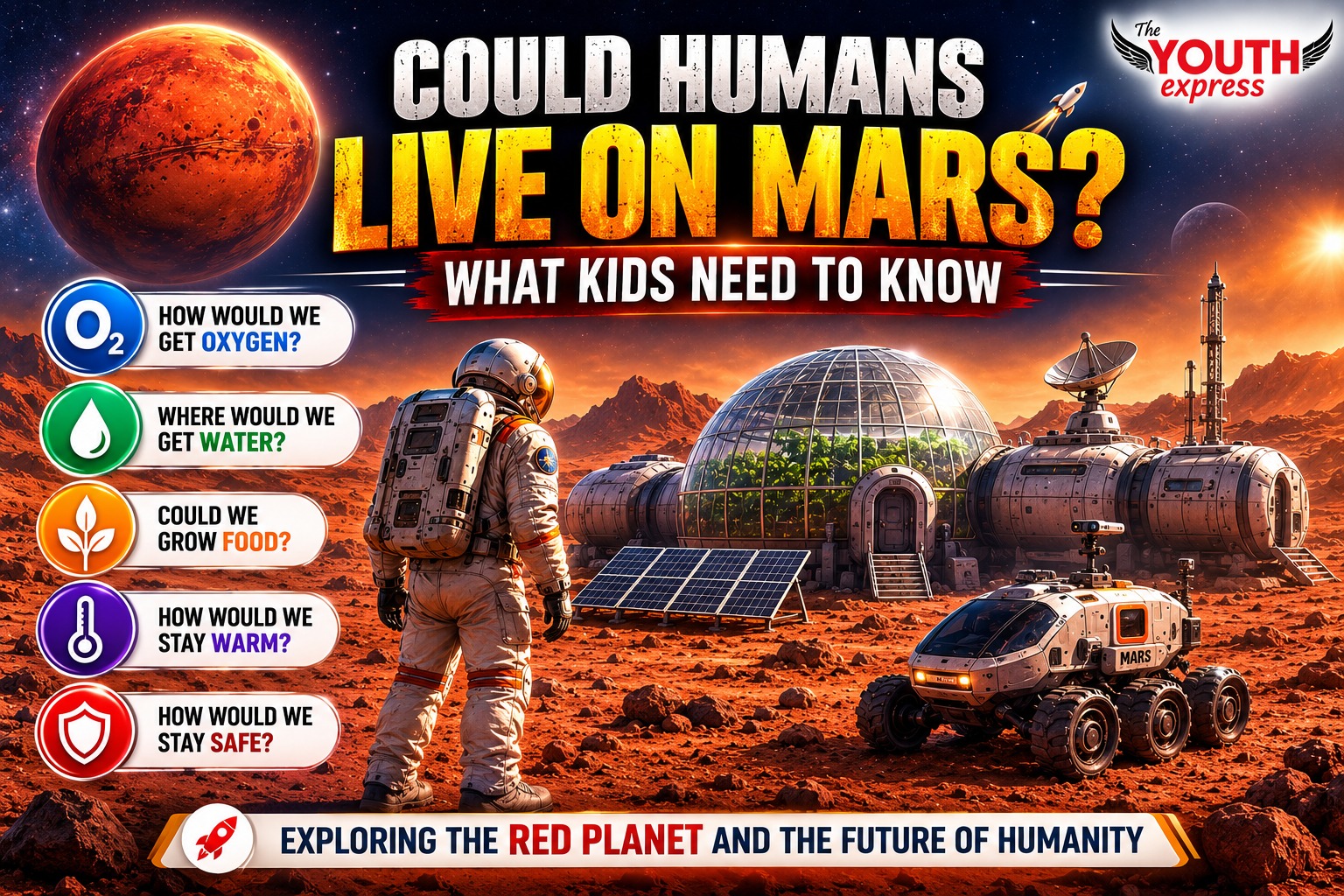
Imagine waking up one morning and looking outside your window. Instead of seeing trees, buildings, or birds, you see a red, dusty landscape stretching as far as you can see. You are on Mars!
It sounds like something from a science-fiction movie, but scientists have been seriously studying what it would take for humans to explore and possibly live on Mars in the future.
So, could humans really live on Mars?
The simple answer is: not yet. Mars is a cold, dry and dangerous world, and humans cannot survive there without special technology. However, scientists are learning more about the Red Planet every day and developing technologies that could make future human missions possible.
Let's find out what makes Mars so challenging—and why scientists are still so interested in it.
Why Is Mars Called the Red Planet?
Mars is the fourth planet from the Sun and is often called the Red Planet because its surface contains iron minerals that have become rusty, giving the planet its reddish appearance.
Mars is smaller than Earth and has a very thin atmosphere. Scientists have also found evidence that Mars was very different billions of years ago. It was once warmer and wetter, with signs of ancient rivers, lakes and other water-related features.
Today, Mars is a cold desert world. Water still exists there, but much of it is found as ice rather than as stable liquid water on the surface.
Can Humans Breathe on Mars?
This is one of the biggest problems.
The air on Earth contains enough oxygen for humans to breathe. Mars does not. Its atmosphere is extremely thin and is made mostly of carbon dioxide.
Although Mars does contain a very small amount of oxygen, it is nowhere near enough for a person to breathe safely. An astronaut standing outside on Mars would need a spacesuit and life-support system to provide breathable air and maintain safe pressure.
This means that future Mars explorers would need to bring oxygen with them or find a way to produce it on the planet.
Interestingly, scientists have already tested an idea that could help.
Can We Make Oxygen on Mars?
NASA's MOXIE experiment was designed to test whether oxygen could be produced from the carbon dioxide in Mars' atmosphere.
MOXIE operated on NASA's Perseverance rover and successfully produced oxygen on Mars. During its mission, it generated a total of about 122 grams of oxygen. Although that is a small amount, the experiment showed that the basic technology can work in the Martian environment.
For future human missions, much larger systems would be needed.
This is an exciting example of how scientists are turning a difficult problem into an engineering challenge.
What Would a Home on Mars Look Like?
Humans could not simply build a normal house on Mars and move in.
A Mars habitat would need to work more like a protective shelter. It would have to provide breathable air, safe pressure and temperature control while protecting astronauts from the harsh environment.
A future Mars habitat could include:
Sleeping and living areas
Air and temperature control systems
Water storage and recycling
Food supplies
Electricity systems
Communication equipment
Scientific laboratories
Protection from radiation and dust
Astronauts would also need spacesuits whenever they travelled outside.
Some future habitats might even be placed underground or covered with Martian material to provide additional protection.
Where Would Humans Get Water?
Water would be one of the most valuable resources on Mars.
Scientists have found evidence of water ice on Mars, including ice beneath the surface and around the polar regions. However, finding water is not the same as having an easy supply of drinking water.
Future astronauts would need to locate, collect and carefully process available water resources.
Water could be used for several important purposes. People could drink it after proper treatment, plants could use it for growing food, and technology could potentially use it to help produce oxygen and other useful resources.
Using resources already available on Mars could reduce the amount of material that astronauts would need to transport from Earth.
Could Humans Grow Food on Mars?
Imagine growing vegetables on another planet!
Future astronauts may need special greenhouses or indoor farms to grow some of their own food. These spaces would have to control temperature, light, water and air.
Growing plants directly in Martian soil would be difficult. Instead, scientists could use carefully controlled growing systems.
Food brought from Earth would still be important, especially during the early stages of exploration. But growing fresh food could make long-term missions more practical and provide astronauts with a healthier and more varied diet.
What Would It Feel Like to Walk on Mars?
Walking on Mars would feel different from walking on Earth because Mars has much weaker gravity.
Mars' surface gravity is about 38% of Earth's gravity. So, a person would weigh much less on Mars than they do on Earth.
This might make jumping and moving around feel unusual. But low gravity could also create challenges for the human body if people stayed there for a very long time.
Scientists need to learn much more about how humans would adapt to living in Mars' gravity for months or years.
Is Mars Dangerous?
Yes. Mars has several conditions that make it dangerous for humans.
The planet is extremely cold, has a very thin atmosphere and experiences dust storms. Its atmosphere also provides much less protection from harmful radiation than Earth's atmosphere.
Astronauts would therefore need strong protection and reliable technology.
A failure in a spacesuit, habitat or life-support system could become a serious emergency. This is why future Mars missions would require careful planning and highly reliable equipment.
How Long Would a Journey to Mars Take?
Mars is very far from Earth, and the distance between the two planets changes as they orbit the Sun.
A spacecraft travelling to Mars would typically spend several months making the journey. During that time, astronauts would live inside a spacecraft with limited space and resources.
They would need food, water, oxygen, medical supplies and equipment for the entire journey.
They would also need to work together as a team and stay physically and mentally prepared.
Why Do Scientists Want to Explore Mars?
The idea of humans living on Mars is exciting, but that is not the only reason scientists study the planet.
Mars may help us understand the history of planets and the possibility of life beyond Earth.
Scientists have found evidence that ancient Mars had environments where liquid water existed. NASA's Perseverance rover has studied rocks and an ancient lake environment while searching for clues about Mars' past habitability.
The big question is:
Did Mars ever have life?
Scientists do not currently expect to find large living creatures walking around on Mars. Instead, they are looking for evidence that microscopic life may have existed there long ago.
What Can Kids Learn From Mars?
Mars is more than a space topic. It is a great example of how curiosity can lead to discovery.
When children ask questions such as “Could humans live on Mars?”, they are already thinking like young scientists.
They have to compare Earth and Mars, understand problems, look for evidence and think about possible solutions. This kind of curiosity can help children develop critical thinking and problem-solving skills.
For more ideas on how reading and learning can strengthen children's thinking skills, explore How Reading Newspapers Builds Critical Thinking in Children, one of the educational articles available on The Youth Express.
Technology will also play a major role in future space exploration. Artificial intelligence, robotics and advanced machines could help astronauts explore places that are difficult or dangerous for humans.
Could Mars Become Our Second Home?
A permanent human settlement on Mars is still a huge challenge.
Scientists would need to solve many problems before people could live there for long periods. They would need reliable oxygen, water, food, energy, safe habitats and protection from radiation.
There is also the question of returning safely to Earth.
So, while we cannot say that humans will definitely live on Mars, research is helping us understand what might be possible.
Perhaps one day, scientists will build a small research base on Mars. Maybe future explorers will grow plants there, study Martian rocks and look for clues about ancient life.
And who knows? Some of today's curious kids could become tomorrow's astronauts, engineers or space scientists.
Conclusion
Could humans live on Mars? Maybe one day, but not yet. Mars is cold, dry, has very little oxygen, and can be dangerous for humans. To live there, astronauts would need special homes, spacesuits, food, water, oxygen, and advanced technology.
Scientists are already working to solve these challenges and learning more about the Red Planet every day. For kids, Mars is a great reminder that curiosity, questions, and learning can lead to amazing discoveries.
Who knows? The children reading about Mars today could become the scientists and astronauts who explore it tomorrow. The future of Mars may be unknown, but the journey to discover it has already