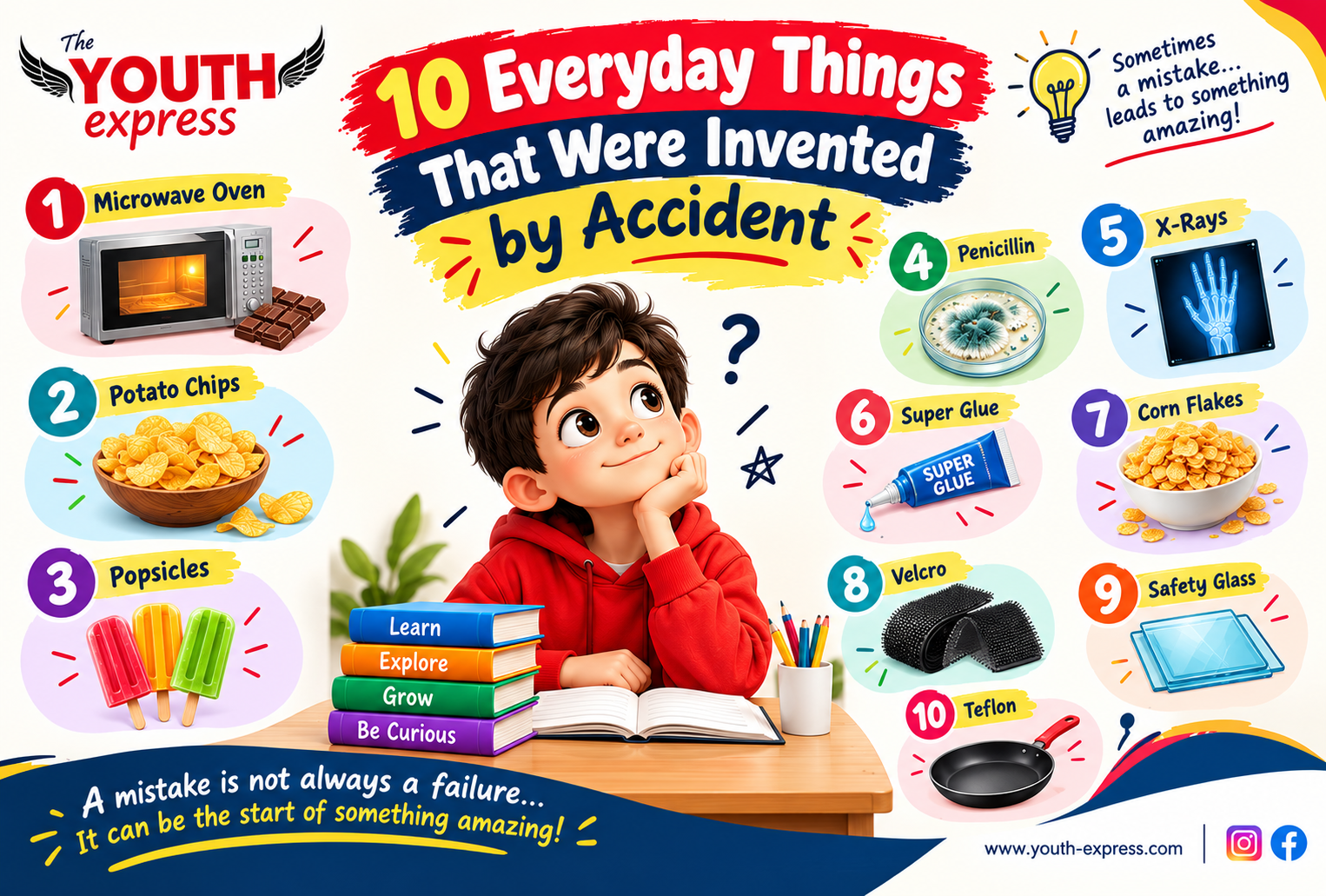
Have you ever thought about how the things around you were invented? From the food we eat to the products we use at home, almost everything has an interesting story behind it. We often imagine inventors spending years planning every detail before creating something new. But surprisingly, some of the world's most useful inventions were discovered completely by accident!
A mistake, an unexpected result, or even a simple observation can sometimes lead to a brilliant idea. The important part is being curious enough to ask, "Why did this happen?"
Here are 10 everyday things that have fascinating stories of accidental discovery.
1. Microwave Oven
The microwave oven is something many families use to heat food quickly. But its discovery was not actually planned.
In the 1940s, engineer Percy Spencer was working with a device called a magnetron, which produces microwaves. During an experiment, he noticed that a chocolate bar in his pocket had melted.
Instead of simply cleaning up the mess, Spencer became curious. He tested the effect on other foods and discovered that microwaves could heat food very quickly.
His unexpected observation eventually helped lead to the development of the microwave oven.
Fun fact: The first microwave ovens were much larger and more expensive than the small ones commonly found in homes today.
2. Potato Chips
Potato chips are a favourite snack for children and adults, but their origin is linked to a popular story about a chef named George Crum.
According to the story, a customer at a restaurant complained that the fried potatoes were too thick. To respond, Crum sliced the potatoes extremely thin, fried them until they became crispy and added salt.
Instead of disliking them, the customer reportedly enjoyed the crunchy potatoes.
Whether every detail of this story is accurate or not, it has become one of the most famous stories about the origins of potato chips.
3. Popsicles
Imagine accidentally creating a frozen treat while you are still a child!
In 1905, 11-year-old Frank Epperson reportedly left a mixture of soda powder, water and a stirring stick outside overnight. The temperature dropped, and the mixture froze.
The next morning, he found the frozen mixture attached to the stick. He had accidentally created a simple frozen treat.
Years later, the idea became known as the popsicle and turned into a popular summer snack.
This story shows that sometimes even a simple accident can become a great idea.
4. Penicillin
Not all accidental discoveries are about food or household products. Some can change people's lives.
In 1928, scientist Alexander Fleming returned to his laboratory and noticed something unusual in one of his dishes. A type of mould had grown in it, and bacteria around the mould were not growing normally.
Fleming investigated the discovery and found that the mould was producing a substance that could stop certain bacteria from growing. This substance became known as penicillin.
Penicillin later became an important antibiotic and changed the treatment of many bacterial infections.
5. X-Rays
X-rays are commonly used by doctors to look at bones and detect certain problems inside the body. But their discovery happened during an unexpected experiment.
In 1895, German physicist Wilhelm Conrad Röntgen was experimenting with electrical equipment. He noticed that a nearby screen began to glow even though it was not directly connected to the equipment.
He investigated further and discovered a new kind of invisible radiation. Because he did not know exactly what it was, he called it "X-rays."
Today, X-ray technology is an important part of modern medicine.
6. Super Glue
Super Glue was not originally being developed as a glue at all.
During World War II, scientist Harry Coover was working on materials that could be used for clear plastic gun sights. One of the substances he tested turned out to be extremely sticky.
At first, this created a problem because the material kept sticking to things. But later, Coover realized that its powerful sticking ability could actually be useful.
The material was eventually developed into a strong adhesive that became widely known as Super Glue.
This is a great example of how a problem can sometimes reveal a useful opportunity.
7. Corn Flakes
Corn flakes have an interesting history connected to an experiment with grains.
Brothers Will and John Kellogg were working with food while caring for patients. During one experiment, cooked grains were left for longer than expected.
When the brothers processed the grains, they became thin and flaky instead of forming the texture they had expected.
They continued experimenting with grains and eventually created a crispy breakfast food similar to the corn flakes we know today.
What started as an unexpected result became one of the world's most familiar breakfast foods.
8. Velcro
Have you ever noticed tiny burrs sticking to your clothes after walking through grass or a field?
Swiss engineer George de Mestral noticed exactly this after a walk with his dog in the 1940s. Tiny burrs had attached themselves to his clothes and his dog's fur.
Instead of simply removing them and forgetting about them, he looked at the burrs under a microscope. He discovered that they had tiny hooks that could catch onto loops in fabric.
Inspired by nature, he developed a fastening system based on this hook-and-loop idea.
The result became Velcro, which is now commonly used on shoes, bags, clothing and many other products.
9. Safety Glass
Glass can be useful, but ordinary glass can break into dangerous pieces. An accidental observation helped inspire a safer type of glass.
French chemist Édouard Bénédictus reportedly dropped a glass flask that had a thin plastic-like coating inside. The glass cracked, but the pieces did not completely fall apart.
This made him curious. He discovered that the coating helped hold the broken glass together.
His work contributed to the development of laminated safety glass, which is now used in products such as car windshields.
10. Teflon
Teflon is famous for its slippery, non-stick properties, especially in cookware.
In 1938, chemist Roy Plunkett was experimenting with gases while working on new refrigerants. When he checked one of his containers, he discovered that the gas inside had unexpectedly changed into a white, slippery solid.
The new material had unusual properties. Further research eventually led to the development of Teflon, which became widely used for its non-stick and heat-resistant qualities.
A surprising result in a laboratory had turned into a material with many practical uses.
What Can We Learn From These Accidental Inventions?
The stories of these inventions teach us an important lesson: a mistake does not always mean failure.
Many inventors could have ignored the unexpected things they noticed. Instead, they stopped, asked questions and investigated what had happened.
That curiosity made all the difference.
For children, this is an especially useful lesson. When something goes wrong during an experiment, a school project or even while playing with a new idea, it can be tempting to give up. But sometimes an unexpected result can lead to something interesting.
The next time you make a mistake, try asking yourself:
"What can I learn from this?"
You never know where curiosity might take you.
Conclusion
From microwave ovens and potato chips to Velcro and X-rays, accidental discoveries have given us many things that we use today. These stories remind us that inventions do not always begin with a perfect plan.
Sometimes, they begin with a mistake, a surprise or a curious question.
At The Youth Express, we believe children learn best when they are encouraged to ask questions and explore the world around them. Every new discovery begins with curiosity—and perhaps one day, today's curious young readers could become tomorrow's inventors!
FAQs
1. What are accidental inventions?
Accidental inventions are products or discoveries that were created unexpectedly while someone was working on another experiment, problem or idea.
2. What are some things invented by accident?
Some well-known examples include the microwave oven, popsicles, penicillin, X-rays, Super Glue and Velcro.
3. Was penicillin really discovered by accident?
Yes. Alexander Fleming noticed that mould growing in a laboratory dish was affecting the bacteria around it. He investigated the unexpected observation, which led to the discovery of penicillin.
4. How was Velcro invented?
George de Mestral noticed burrs sticking to his clothes and his dog's fur. After examining them closely, he developed a fastening system inspired by their tiny hooks.