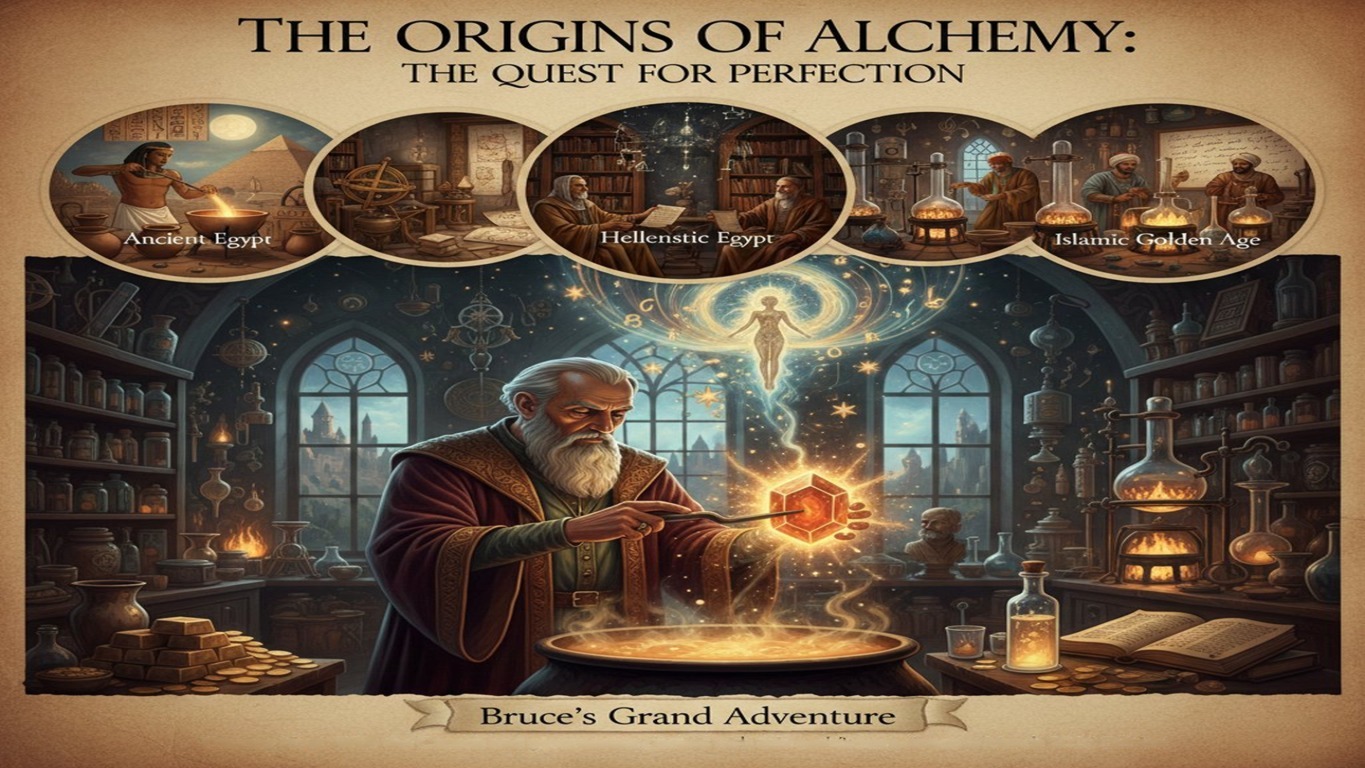
The Origins of Alchemy: The Quest for Perfection (Part 1)
Alchemy is one of the most fascinating chapters in human history - a mysterious blend of
science, philosophy, and spiritual ambition. Long before modern laboratories and chemistry
textbooks, alchemists were searching for nothing less than perfection itself.
Hello, I’m Bruce, and today we’re diving into a history that feels more like a grand adventure -
the story of alchemy.
When you hear the word “alchemist,” you might imagine a strange scientist in a dark tower
trying to turn lead into gold. While that image isn’t entirely wrong, the real mission of alchemy
was far more ambitious than simple treasure-making.
The Grand, Three-Headed Goal
Alchemy wasn’t just a science or a magical practice. It was a unique discipline combining
philosophy, spiritual exploration, and early chemistry. Alchemists pursued three powerful,
interconnected goals:
1. Chrysopoeia - The Gold Quest
Alchemists believed that base metals like lead were imperfect forms of gold. Their goal was to
accelerate nature’s process and transform these metals into noble gold. To them, gold
symbolized purity and perfection.
2. The Elixir of Life - The Health Quest
Another dream was to create a Panacea - a universal cure that could heal all diseases and even
grant immortality. If they could perfect metal, they believed they could perfect the human body
as well.
3. Spiritual Transformation
Alchemy wasn’t only about physical change. It was also a metaphor for inner purification. As metals were refined, the alchemist’s soul was meant to be refined too, leading to wisdom and enlightenment. Alchemy wasn’t only about physical change. It was also a metaphor for inner purification. As metals were refined, the alchemist’s soul was meant to be refined too, leading to wisdom and enlightenment.
Where It All Began
Alchemy did not start in one single place. Instead, it emerged independently in three great
ancient centers that later influenced one another.
Ancient Egypt - The Technical Root
In Ancient Egypt, practical skills like metallurgy, dyeing, and embalming laid the foundation for
alchemical practices. Even the word “alchemy” comes from “Khemia,” meaning “the black land,”
a reference to Egypt.
Hellenistic Egypt (Alexandria) - The Philosophical Fusion
In Alexandria, Egyptian knowledge merged with Greek philosophy, especially the ideas of
Aristotle about the four elements. This era also connected alchemy to mystical teachings
attributed to Hermes Trismegistus, giving it a spiritual dimension.
The Islamic Golden Age - The Empirical Leap
During the Islamic Golden Age, scholars such as Jabir ibn Hayyan preserved ancient texts and
transformed alchemy into a more experimental science. They introduced systematic
experimentation and developed techniques like distillation and sublimation - methods still used
in chemistry today.
The Search for the Philosopher’s Stone
Knowledge from the Islamic world eventually spread to Europe in the 12th century, igniting
medieval fascination with the legendary Philosopher’s Stone - a substance believed capable of
achieving all three alchemical goals at once: turning metals into gold, healing disease, and
granting spiritual perfection.
The Journey Continues…
Alchemy was bold, mysterious, and sometimes controversial. As its influence grew, religious
and political authorities began to worry about its power and ambitions.
What happened next would shape the fate of alchemy forever.
Coming Next:Why the Church and governments clashed with this ambitious science - March
2026 Edition.