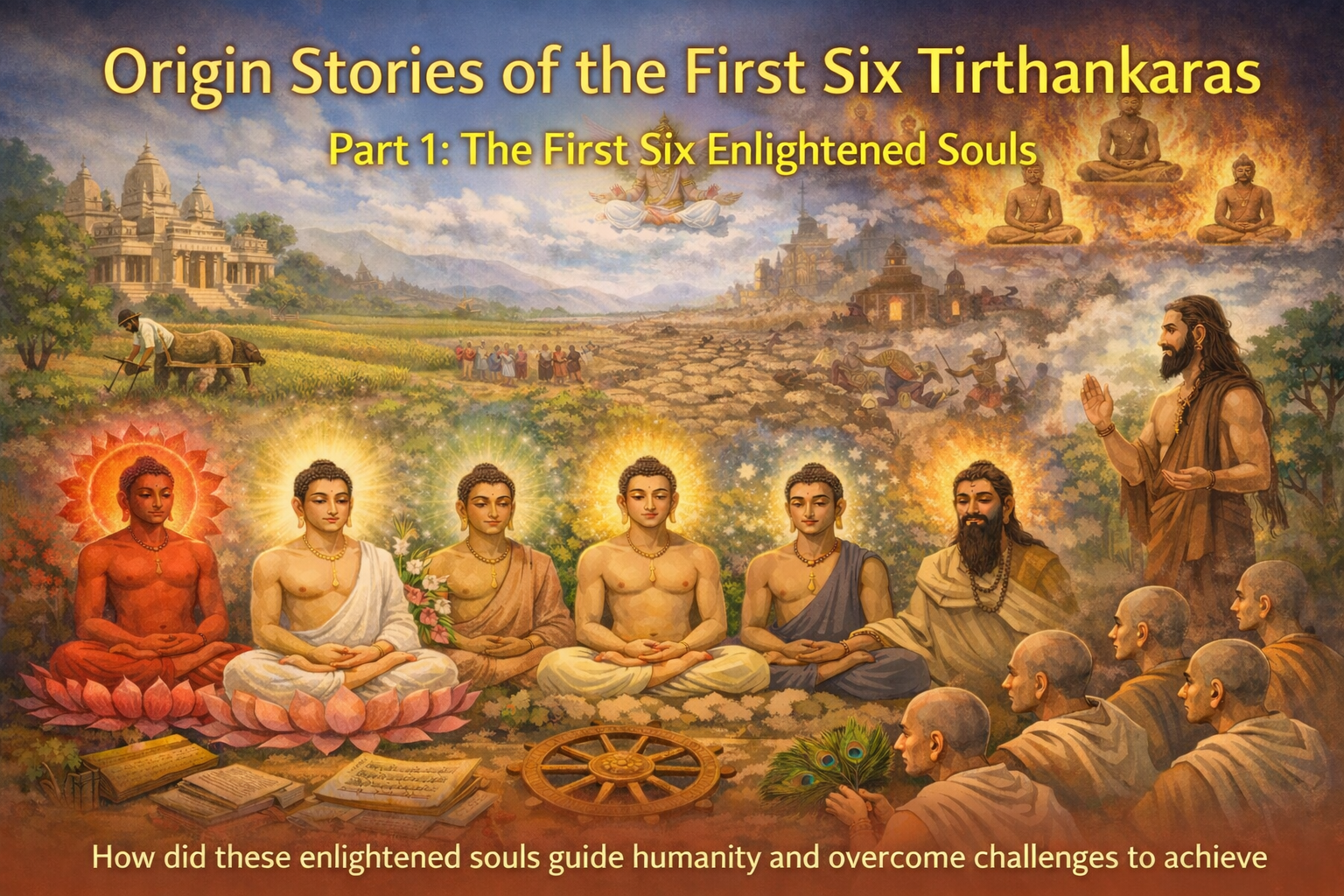
Origin Stories of the First Six Tirthankaras (Part 1)

Part 1: The First Six Enlightened Souls

A common theme in Jain tradition is that every Tirthankara’s soul resides in a heavenly realm as a deva before
descending into a noble human lineage for the final birth.


1. Rsabhanātha (Ādinātha)


Past Life (Pūrva Bhava):
In a previous life, he was King Mahābala in the Pūrvā Videha region. Through deep renunciation and strict
ascetic practices, he accumulated the Tirthankara-nāma-karma.

Birth: His soul descended into the womb of Queen Marudevī of Ayodhyā, who experienced fourteen auspicious
dreams.

Parents: King Nābhi and Queen Marudevī.

Significance: Ṛṣabhanātha is the first Tirthankara of the current time cycle. Born at a time when humanity was still
uncivilized, he introduced agriculture, arts, governance, and social organization, thereby establishing both
dharma and civilization.

2. Ajitanātha


Past Life (Pūrva Bhava):
He was reborn as a deva in the Aparājita Vimāna after practicing intense austerities as King Vimala.

Parents: King Jitāśatru and Queen Vijayā of Ayodhyā.

Significance: His name means “The Unconquered.” He appeared soon after Ṛṣabhanātha and continued strengthening
the spiritual path that had just been established.

3. Sambhavanātha


Past Life (Pūrva Bhava):
After living as King Udirna and performing severe penance on an island, he was reborn as a deva in the
Aparājita Vimāna.

Parents: King Jitari and Queen Susenā of Śrāvastī.

Significance: According to tradition, his birth ended a severe drought and famine, symbolizing the prosperity and
spiritual abundance brought by his presence.

4. Abhinandanātha


Past Life (Pūrva Bhava):
He attained rebirth as a deva in the Vaijayanta Vimāna after spiritual practices as King Saṅgama in
Vatsadeśa.

Parents: King Saṃvara and Queen Siddhārthā of Ayodhyā.

Significance: His birth filled the kingdom with joy and celebration. His name means “One who is worshipped with
delight.”

5. Sumatinātha


Past Life (Pūrva Bhava):
He became a deva in the Jayanta Vimāna after a disciplined ascetic life as King Meghaprabha.

Parents: King Megharatha and Queen Maṅgalā of Ayodhyā.

Significance: His name means “Right Understanding” or “Pure Intellect.” During pregnancy, his mother’s thoughts were
said to become exceptionally focused on dharma.

6. Padmaprabha


Past Life (Pūrva Bhava):
After practicing asceticism as King Aparājita in Pūrvā Videha, he was reborn as a deva in the Sarvārthasiddhi
Vimāna.

Parents: King Dharaṇa and Queen Suśīmā of Kauśāmbī.

Significance: During pregnancy, his mother longed to rest on beds of red lotus flowers. He was born with a soft red glow,
earning the name “Padmaprabha”—Light of the Red Lotus.


The Twist…


These six Tirthankaras laid the spiritual foundation that would guide countless souls toward liberation. But
their journeys did not end with birth alone.

What challenges awaited them as they grew, renounced worldly life, and walked the path to enlightenment?
How did their teachings shape generations to come?


👉To continue reading this sacred journey, subscribe to our newspaper and don’t miss the next part
of this inspiring series.

Coming Next: Part 2 – The Path to Renunciation and Enlightenment (February 2026 Edition)